

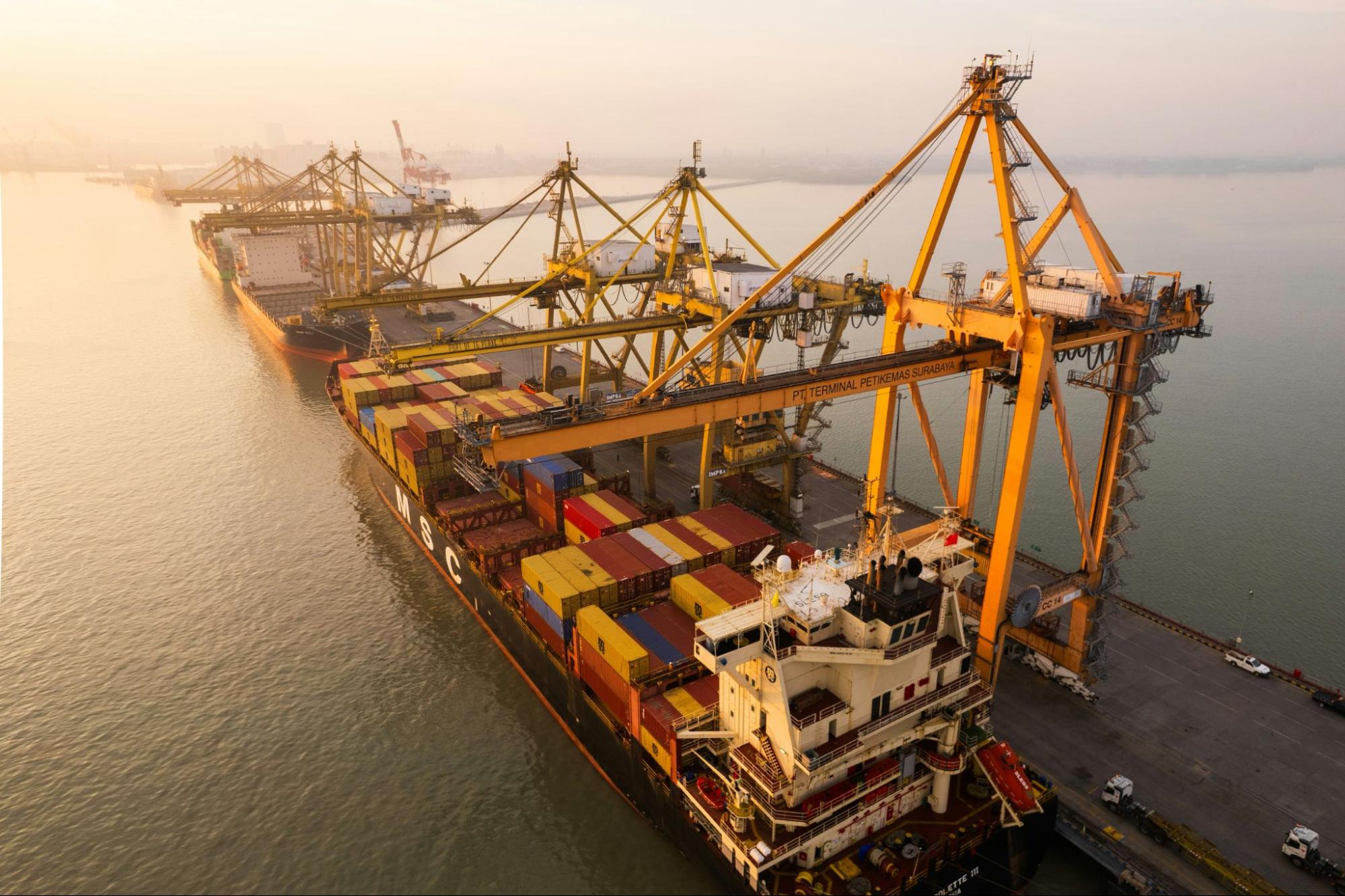
The popular image of global trade is physical: massive container ships crossing oceans; cranes lifting steel boxes with mechanical precision; trucks queuing outside warehouses. These visuals suggest that global commerce depends primarily on moving goods efficiently. In reality, its greatest vulnerability lies elsewhere — in coordination.
Companies at the center of global commerce still rely on brittle systems like Microsoft Excel to reconcile data across partners. Each firm has its own spreadsheet, and every handoff creates the potential for disagreement. Small inconsistencies accumulate over time until someone manually resolves them.
Yet blockchains, when designed in an efficient manner, can offer a much more reliable accounting technology. They can allow independent participants to record and access information on the same shared system, making global coordination easier, faster, and cheaper. The resulting economic benefits would be massive.
Using blockchains for accounting
Global trade depends on accounting. Every shipment reflects a chain of recorded facts — ownership, location, custody, and payment status. When these records diverge, physical movement slows or stops.
Spreadsheets discourage data sharing. Companies maintain isolated records to preserve control, creating silos that slow coordination. This fragmentation makes sense under current tools yet imposes system-wide costs.
But blockchains are well suited to serve as shared accounting infrastructure. They provide a single ledger that all participants can reference. Having fewer competing versions of a record reduces the need to reconcile accounting conflicts.
This system does not need to be perfect to be useful; it only needs to be shared. A distributed ledger establishes a common reference point, allowing participants to coordinate around the same information.
The coordination tax
Many delays in global trade originate in broken information flow. A shipment may arrive at port on schedule but remain frozen because of a mismatched SKU number, or a timestamp inconsistency can trigger compliance checks.
Behind the scenes, large teams exist primarily to reconcile discrepancies. Operations staff compare spreadsheets, search email chains, and resolve conflicting records. This work rarely appears in logistics performance metrics, yet it represents a substantial operational cost. A recent report suggested that the manual processing of trade finance documents costs the global trade system about $1.8 trillion annually.
Blockchains reduce this overhead by creating a shared accounting layer from the outset. Instead of reconciling separate records after discrepancies emerge, participants operate against synchronized information in real time.
Integration complexity also declines. Today’s systems rely on point-to-point connections. If ten companies need to exchange data, dozens of integrations must be built and maintained. Each introduces maintenance overhead and potential failure points. A shared ledger simplifies this architecture, since participants integrate once and interact with all other participants through the same system.
Large organizations have already explored this model. TradeLens, developed by IBM and Maersk, demonstrated how shipping data could be shared across carriers, ports, and customs authorities through a distributed ledger. While adoption challenges limited its long-term success, the experiment highlighted the magnitude of coordination inefficiencies in existing systems.
Provenance requirements are also expanding. Consumers want visibility into how products are sourced, and regulators demand traceability. Spreadsheet systems can track internal activity, but sharing trusted records externally remains difficult. A shared ledger allows companies to maintain operational records while exposing verifiable provenance to partners and customers. In fact, even Walmart has experimented with blockchain-based tracking to strengthen supply chain transparency.
Accounting for reality
Spreadsheets were never designed for shared, multi-party accounting. Files can be edited without durable history, versions proliferate, and audit trails are incomplete or nonexistent. When disputes arise, it is usually slow and expensive to reconstruct events.
One major allure of blockchains is that activity is recorded chronologically and immutably. Entries cannot be quietly rewritten. When it comes to accounting, that means participants can review a full sequence of events without relying on fragmented records scattered across organizations. Auditability is an inherent property of the system. This can be particularly alluring when it comes to enhancing supply chain transparency of sensitive items like food labels or healthcare equipment.
Spreadsheets will remain valuable tools for internal analysis and planning. They offer flexibility that structured systems cannot easily replicate. But as the backbone of global coordination, they impose growing costs.
After all, modern supply chains are growing evermore complex, operating across continents and time zones; they thus require accounting infrastructure that properly supports them. Blockchains provide that foundation by aligning participants around a common record.