
When a financial institution evaluates a business, the process typically begins with a fundamental question: Who is this company? The legal name is verified, registration records are reviewed, addresses are validated, and ownership and other risk indicators may be assessed.
These checks provide an essential foundation, but they primarily tell us about the business as an individual entity. Through my work with business and financial-risk data, I have found that an equally important question is often overlooked: What other businesses is this company connected to?
Consider two merchants applying for financing. Both have active registrations, consistent business information, and no immediate concerns in the records being reviewed. Evaluated independently, they may appear to present similar risk profiles.
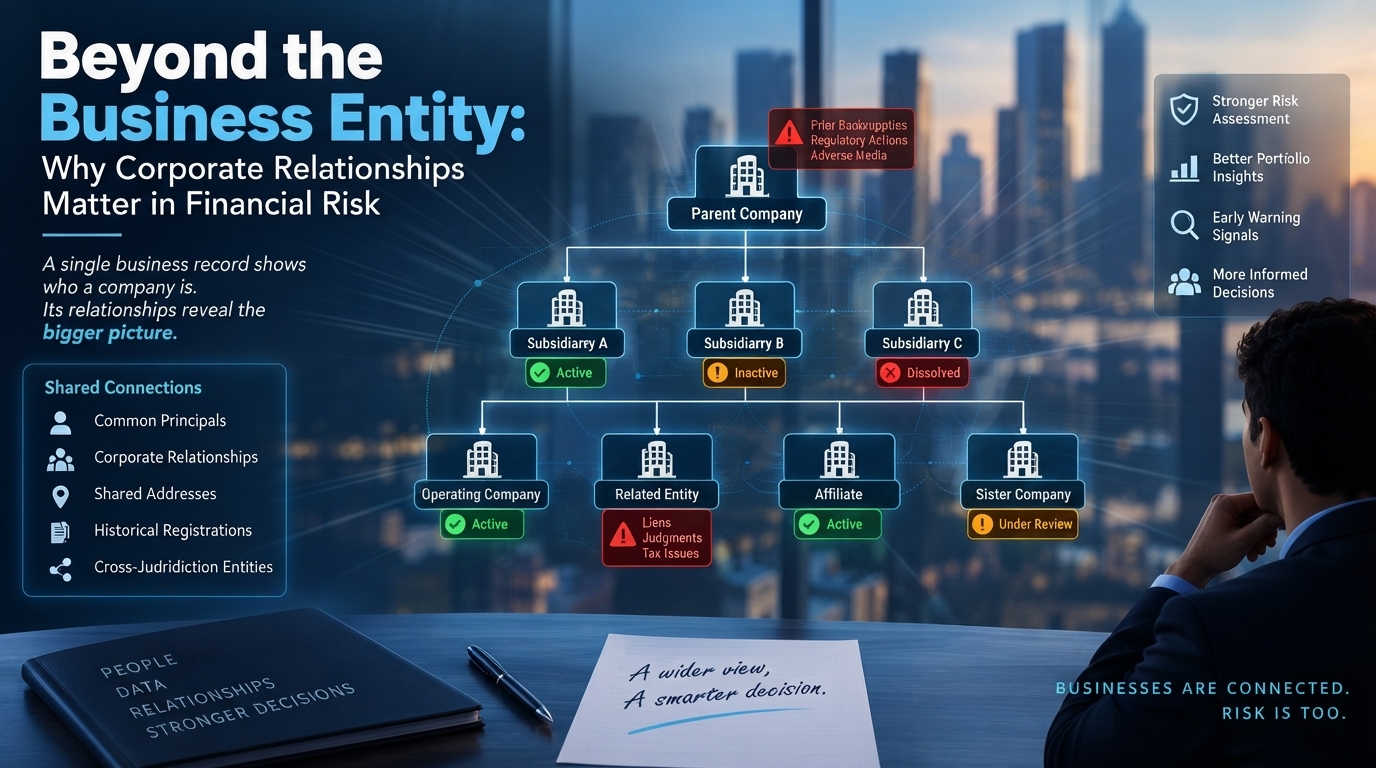
Now suppose one merchant is connected to several other businesses through common principals, corporate relationships, shared addresses, or historical registrations. Some of those businesses may be inactive or closed, while others may contain information that warrants additional review. This does not automatically make the merchant higher risk, but it introduces valuable context that cannot be seen by evaluating the business in isolation.
The individual business record tells us who the company is. Its relationships can help us understand the broader picture around it.
Understanding Corporate Hierarchy and Business Relationships
Corporate hierarchy does not have to be a complicated technical concept. At its simplest, it is a way of understanding how businesses and the people behind them are connected.
A company may have a parent organization. That parent may own multiple subsidiaries. A principal may be associated with several businesses, and companies may operate under different legal entities or registered names across different jurisdictions.
Instead of seeing each company as an isolated record, corporate hierarchy organizes those relationships into something closer to a business family tree. That shift – from looking at a single entity to understanding the broader family – can be especially valuable in financial services.
Why These Relationships Are Difficult to See
The challenge is that businesses do not exist inside one clean national database. In the United States, corporate registration information is distributed across states and jurisdictions, and records can differ in structure, terminology, completeness, and availability [1].
Names create another complication. The same organization may appear under a legal name, a trade name, an abbreviation, or a slightly different variation in another record. Addresses change. Officers change. Businesses merge, dissolve, reorganize, or create new entities.
The result is a problem familiar to anyone who has worked with large business datasets: the information may exist, but the complete picture may not exist in one place. Finding a business record is therefore not the same thing as understanding the business.
Why This Matters for KYB
Know Your Business, or KYB, helps organizations establish that a company is legitimate and understand who is behind it. A lender or financial platform may need to know whether the business exists, whether its registration is active, and whether information supplied by the applicant is consistent with trusted sources [2].
But verification answers only part of the question. An active registration does not automatically reveal whether the same principal operates several other companies, whether the business belongs to a larger organization, or whether related entities appear elsewhere in a portfolio.
Corporate hierarchy adds context to verification. It moves the question from “Is this business real?” to “What is the broader business environment around this company?”
When Individual Business Risk Becomes Connected Risk
Risk does not always stay neatly contained within one legal entity. Consider a lender with exposure to three businesses: Alpha Services, Brightway Solutions, and Central Commerce. On paper, they appear to be three unrelated customers, and each passes the lender’s normal business-level checks.
Later, the lender discovers that all three belong to the same broader corporate family. Its apparent exposure to three independent businesses may actually represent concentrated exposure to one connected organization.
Nothing about the individual business records necessarily changed. What changed was the lender’s understanding of the relationships between them. That distinction can matter in underwriting, portfolio management, fraud investigations, compliance reviews, and ongoing monitoring.
The Difference Between a Match and a Relationship
One lesson I have learned from working extensively on corporate-hierarchy and business-association problems is that finding similarities is relatively easy. Interpreting what those similarities mean is much harder.
Two companies sharing an address does not automatically mean they belong to the same corporate family. Many legitimate businesses operate from shared office buildings. Likewise, seeing the same person associated with two businesses does not by itself establish ownership or control.
This is where corporate hierarchy becomes more than a data-matching exercise. The objective is not to create as many connections as possible; it is to identify relationships with enough supporting context to be useful. In financial risk, an incorrect relationship can be just as problematic as a missed one.
From Individual Risk to Family-Level Context
The most useful way I have come to think about corporate hierarchy is as an additional layer of context. Traditional risk analysis often focuses on the individual business: business, information, and risk assessment.
Corporate hierarchy introduces another perspective: business, relationships, corporate family, and broader risk context.
This does not mean that a problem associated with one company should automatically be attributed to every related business. Instead, relationships can help determine where additional investigation may be appropriate.
If one member of a corporate family experiences financial distress, that information may not automatically make another member high-risk. But knowing that the relationship exists allows an analyst to ask better questions. That is fundamentally different from treating every business as an isolated record.
Seeing Risk Across the Broader Portfolio
Corporate hierarchy becomes particularly interesting when it is applied across an entire portfolio rather than to a single application. Imagine a financial institution believes it has financed 1,000 independent businesses.
After understanding corporate relationships, it discovers that a portion of those businesses belong to the same corporate families. The number of accounts has not changed, but the institution’s understanding of its concentration may have.
This broader view can help risk teams identify clusters of exposure that might otherwise remain hidden across separate merchant records. For lenders, payment companies, fintech platforms, and other financial organizations dealing with large business populations, that context can become increasingly important as portfolios grow.
Where Technology Meets Human Judgment
Modern data infrastructure, entity-resolution techniques, and AI can make it easier to analyze large volumes of business information and surface potential relationships. But technology should not turn every similarity into a conclusion.
Corporate structures can be messy. Data can be incomplete, and historical records can conflict with current information. Strong systems therefore need to distinguish between possible relationships and relationships supported by sufficient context.
Technology can surface the connections. People still need to understand what those connections mean. That balance is especially important when the results influence consequential financial decisions.
The Bigger Picture Behind Business Risk
The financial industry has invested heavily in getting better at verifying businesses. The next opportunity is to become better at understanding businesses in context.
A legal entity is important, but it is only one part of the picture. Businesses have owners, officers, affiliates, subsidiaries, parents, histories, and relationships that can extend beyond a single registration record.
When those relationships become visible, financial institutions can ask better questions about identity, exposure, concentration, and risk. That is why corporate hierarchy should not be viewed simply as another data-enrichment exercise; it is a different way of looking at business risk.
Sometimes the most important information about a company is not contained within the company’s own record. It is found in the relationships surrounding it.