
For years, companies obsessed over the click. Search visibility was measured by whether a customer saw a result, chose the link and entered the company’s digital property. That sequence is breaking.
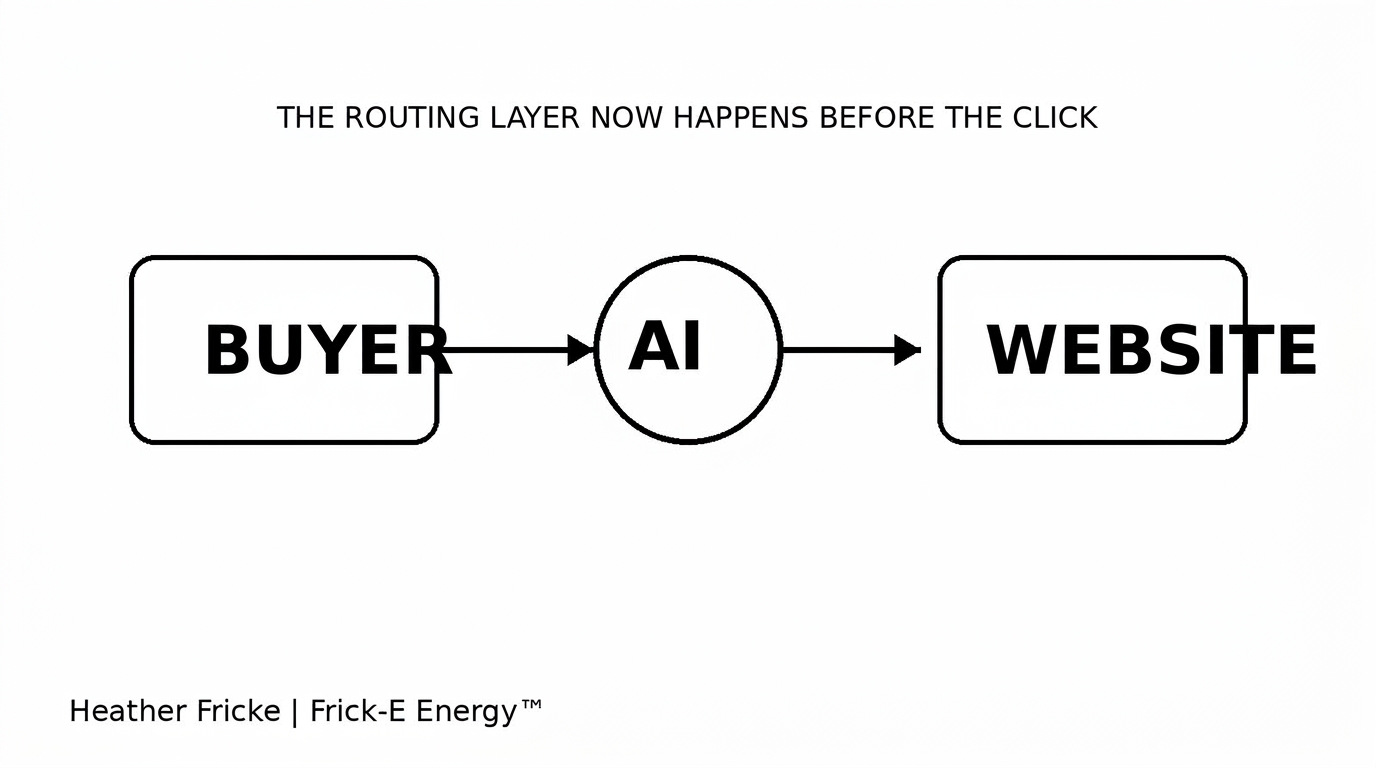
A growing share of commercial discovery now happens inside AI interfaces before a buyer ever sees the company’s homepage. The user asks for the best option, the safest vendor, the provider that fits a specific use case or the product worth comparing. The system does not simply return ten links. It interprets the request, assembles evidence, compares alternatives and routes the user toward a conclusion.
That routing layer is becoming commercially important faster than many businesses realize.
Reuters reported on August 7 that Adobe Analytics found 41% of U.S. consumers used generative AI for online shopping in June. Visitors referred by AI services generated 41% more revenue per visit than shoppers arriving through traditional channels. Retailers including Walmart, Ulta Beauty and Wayfair are already changing how their public information is structured so AI systems can understand and surface products more effectively.
Shopify’s Q1 2026 commerce data points in the same direction. AI-referred sessions grew more than eightfold year over year and AI-referred orders grew nearly thirteenfold. On product-detail-page sessions, AI-referred visitors converted at nearly 50% higher rates than organic-search visitors, while orders carried 14% higher average order values.
The numbers matter, but the structural change matters more. AI discovery compresses the journey. A traditional buyer may search repeatedly, visit category pages, compare several sites and gradually narrow the decision. An AI-assisted buyer can ask a highly specific question and arrive at a recommended product, provider or source already several steps into the decision process.
That means the most important visibility question is changing from ‘Can the buyer find us?’ to ‘How does the system decide whether to route the buyer toward us at all?’
The recommendation can happen before the visit
This is where many organizations are still using the wrong mental model.
They assume AI discovery is a new version of SEO. Improve keywords, add schema, publish more content and wait for the traffic. Those things still matter, but they do not fully explain what happens inside a generative recommendation.
An AI system has to identify the entity correctly. It has to understand what the company or expert actually does. It has to distinguish that authority from nearby competitors. It has to decide which public evidence is credible enough to use. Then it has to translate that evidence into an answer that fits the user’s question.
A failure at any one of those stages can alter routing.
A business can rank well in conventional search and still be described generically by an AI system. A specialist can have years of public work and still be flattened into a broad category. A company can be cited for one fact while a competitor receives the recommendation because the competitor’s offer is easier for the system to interpret.
The result may never look like a traditional traffic loss because the rejected business never receives the visit in the first place.
AI-readable is not the same as AI-recommendable
Being technically accessible to a model is only the beginning.
Shopify now tells merchants to make product data more legible to agents and to strengthen trusted external evidence, including editorial coverage and original research. Its guidance reflects an uncomfortable reality: a system cannot confidently recommend what it cannot confidently understand.
The problem becomes sharper outside ecommerce, where there is no clean product feed.
Consider a consulting firm, association, attorney, software company or independent expert. The system may have to infer authority from an About page, media mentions, biographies, service pages, reviews, interviews, public documents and third-party references. If those sources conflict, use vague language or describe the same expertise differently, the model has to reconcile the ambiguity itself.
That is a poor place to outsource identity strategy.
The public web was already a distributed reputation system. AI turns it into a distributed interpretation system.
The market needs a better authority measurement stack
A screenshot showing that ChatGPT mentioned a company is not enough to establish authority.
The useful measurement stack separates several outcomes that are often collapsed into one score: discovery, entity accuracy, interpretation fidelity, evidence use, attribution, routing and commercial consequence.
Those outcomes are related, but they are not interchangeable.
A business can be discoverable but misunderstood. It can be cited but not recommended. It can be correctly described but lose the routing decision. It can receive AI referral traffic that converts unusually well even while total traffic remains small.
Treating all of those conditions as ‘AI visibility’ hides the actual problem.
Authority now has to survive translation
Human authority used to be judged mainly by other humans. A buyer read the article, attended the conference, saw the credential, knew the reputation or received a referral.
That human layer still matters. Now the evidence increasingly passes through an intermediary before reaching the buyer.
The machine retrieves it, summarizes it, compares it and decides how much of it belongs in the answer.
The authority therefore has to survive translation.
That is the practical idea behind what I call Machine-Readable Authority™: public identity, evidence and expertise made clear enough that systems can identify, distinguish, attribute, interpret and route it without flattening the underlying human authority into a generic category.
This is one application of a larger problem I describe as the human-AI understanding gap: the distance between what a human or organization means and what a machine can actually reconstruct from the evidence it receives.
Promptology™ is how I work across that gap: exposing meaning, testing what survived the transfer, and correcting what did not. Human Algorithm™ is the human logic underneath the words — the context, distinctions, priorities and lived reasoning that make authority more than a pile of searchable phrases.
This is not about writing for robots instead of people. The strongest source material usually improves both. Clear definitions help buyers. Consistent descriptions reduce confusion. Strong evidence increases credibility. Original research creates something worth citing. Precise distinctions help both humans and machines understand why one authority is not interchangeable with another.
The expensive failure will often be invisible
The danger for businesses is that AI-mediated routing can fail quietly.
There is no abandoned-cart alert when the system never recommends the company. There is no lost-lead notification when an AI comparison sends the buyer elsewhere. Nobody emails the founder to explain that the model understood the business as a generic service provider instead of the specialist it actually is.
The decision simply happens somewhere else.
That makes this less like a conventional traffic problem and more like an interpretation-risk problem.
Companies need to test the questions buyers are actually asking, preserve the answers, compare systems, trace the evidence being used and watch whether public changes alter the recommendation. They need to know what their authority looks like after it passes through the machine, not merely what they intended to publish.
AI is becoming a routing layer between public evidence and human decisions. The businesses that understand that shift early will stop treating machine interpretation as a curiosity and start treating it as part of commercial infrastructure.
The buyer may still end up on the website. The more important question is who decided they should go there.