

The age of the AI pilot is ending. Not with an announcement, but with exhaustion. The whole ritual of experimenting for its own sake is about to become something no serious company can defend, and the signs are already everywhere for anyone willing to read them.
You know the ritual, because you’ve probably lived it. A demo dazzles. A proof of concept gets funded. A clever prototype works beautifully in one tidy corner of the business. And then, somewhere between the demo and the day it was supposed to matter, the thing quietly loses altitude. Nobody kills it. It just stops coming up in meetings. Multiply that by every department in a large company, and you get the defining feeling of enterprise AI so far. Enormous motion, almost no movement.
That era is closing. What replaces it will look less like a laboratory and more like an investment desk.
The pilots don’t fail for the reason you think
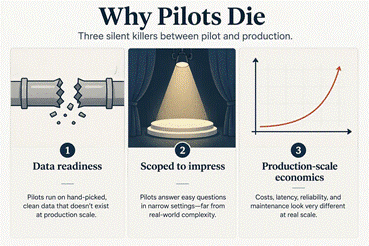
The comforting story you often hear is that pilots stall because the technology isn’t ready yet. That story is wrong, and clinging to it is costing companies real money. The failures are almost never about the model. They are about the organisation around it.
A pilot thrives in a clean, curated corner, and then shatters the moment it meets the real world. The pristine data doesn’t exist at scale. The workflow someone built to impress a steering committee was never the workflow that actually needed solving. The economics that felt reasonable in a small trial turn frightening the moment real volume shows up. None of that is an engineering problem. It is a problem of discipline, ownership, and plain honesty, and those are far harder to fix than a model.
So here is the prediction, in the simplest terms it can be put.
Within a couple of years, “we are piloting AI” will land in a boardroom the way “We are still evaluating cloud” would land today. A confession, not a strategy.
Agentic AI is where the reckoning lands
The correction becomes impossible to ignore at the frontier everyone is rushing toward right now, which is agentic AI. A great deal of what gets sold as an “agent” today is older automation wearing a new costume, shipped without clear ownership, without guardrails, and without any reason to exist beyond the fear of being left behind.
A large share of those projects will not survive the next two years. That is not a tragedy. It is the market finally doing its job. They will not die because agents don’t work. They will die because they were never scoped, never governed, and never asked to prove their worth before the money went out the door. This reckoning is not a distant risk. It is being written into budgets this quarter, in the projects that are quietly going unrenewed.
What replaces the pilot: The Portfolio
Here is the future to bet on. Enterprises stop treating AI as a pile of experiments and start running it the way a good investor runs a portfolio, or the way a serious lab runs its pipeline. Four things change, and the shift is already underway in the companies that are pulling ahead.
Money moves in stages. No more sprinkling equal little bets across dozens of proofs of concept. Funding gets released in stages, and a project earns its next round by clearing a real gate. Evidence, not enthusiasm. Venture capital and drug development already work this way, and AI fits that shape almost perfectly, because most bets go nowhere and a rare few pay for everything.
Success gets defined before the first line of code. The projects that survive will be the ones that named their target up front, in numbers a finance leader would actually recognise. No metric, no start. The vague “let’s just see what AI can do here” project is going extinct.
Killing a project becomes a win. This is the hard one, and the one that matters most. Right now, stalled pilots don’t get killed. They get abandoned, with the money already spent and nothing learned. The best organisations will flip that completely. A clean, early kill means capital returned, a guess disproven cheaply, a lesson banked for the next bet. The companies that learn to stop gracefully will pull away from the ones that let projects die of neglect.
Focus beats sprawl. Not thirty shallow experiments, but a handful of deep bets carried all the way into production. Narrow and committed beats the scattergun every single time.
The test that’s coming, whether we like it or not
If you are a CIO or a leader who runs technology in an enterprise, your job is about to change right underneath you, from enabling experiments to governing a portfolio. Fewer, better bets. A review process that actually has the authority to stop things. And the nerve to walk into a boardroom and call a cancelled project a sign of discipline rather than a failure.
Three questions will decide every project sitting on your desk.
- Does it have the data to survive contact with production?
- Does it have a definition of success a finance leader would sign off on?
- Does someone actually own it if it graduates?
Miss even one, and it isn’t a pilot. It is a science project with a budget. And those are exactly what is about to get defunded.
The pilot era gave us permission to experiment without accountability. That permission is expiring, and it is the best thing that could happen to enterprise AI. What comes next is less thrilling and far more useful. AI treated as a managed set of business bets, most of them stopped on purpose, so the few that truly matter can finally reach the balance sheet.
The companies that win the next cycle will not be the ones that ran the most experiments. They will be the ones that got good at ending them.