

Enterprise infrastructure teams are investing heavily in storage capacity, distributed workloads, and hybrid architectures. The visible story is expansion: more data, more applications, and more connected systems.
The quieter challenge is visibility. Storage fabrics have grown into highly distributed environments with thousands of switches, hundreds of thousands of ports, and operational requirements that demand constant awareness. Yet many discovery and monitoring approaches were designed for smaller networks and struggle when topology complexity accelerates.
The real infrastructure challenge is no longer simply managing more devices. It is ensuring that monitoring systems scale at the same pace as the environments they observe. The winners will be organisations that redesign observability as a high-throughput engineering discipline, not as a collection of polling processes and dashboards.
The Burning Platform: When Visibility Falls Behind Infrastructure Growth
Scale Pressure: Enterprise fabrics have outgrown sequential monitoring models. Modern storage networks in financial services, healthcare, and telecommunications environments can span thousands of switches and hundreds of thousands of ports. Systems designed around sequential discovery cycles create blind spots because the time required to collect and process information grows with every additional endpoint.
Operational Pressure: Detection delays create business risk. Network and storage incidents are rarely caused by a single failure. They emerge from patterns: latency changes, degraded links, resource contention, or configuration drift. When monitoring platforms cannot process telemetry quickly enough, engineers discover problems after applications experience impact rather than before.
Compliance Pressure: Regulators expect demonstrable control. Regulated industries increasingly need evidence that critical infrastructure is monitored, secured, and operationally governed. Audit readiness depends not only on having monitoring systems but also on proving that those systems provide complete and timely visibility.
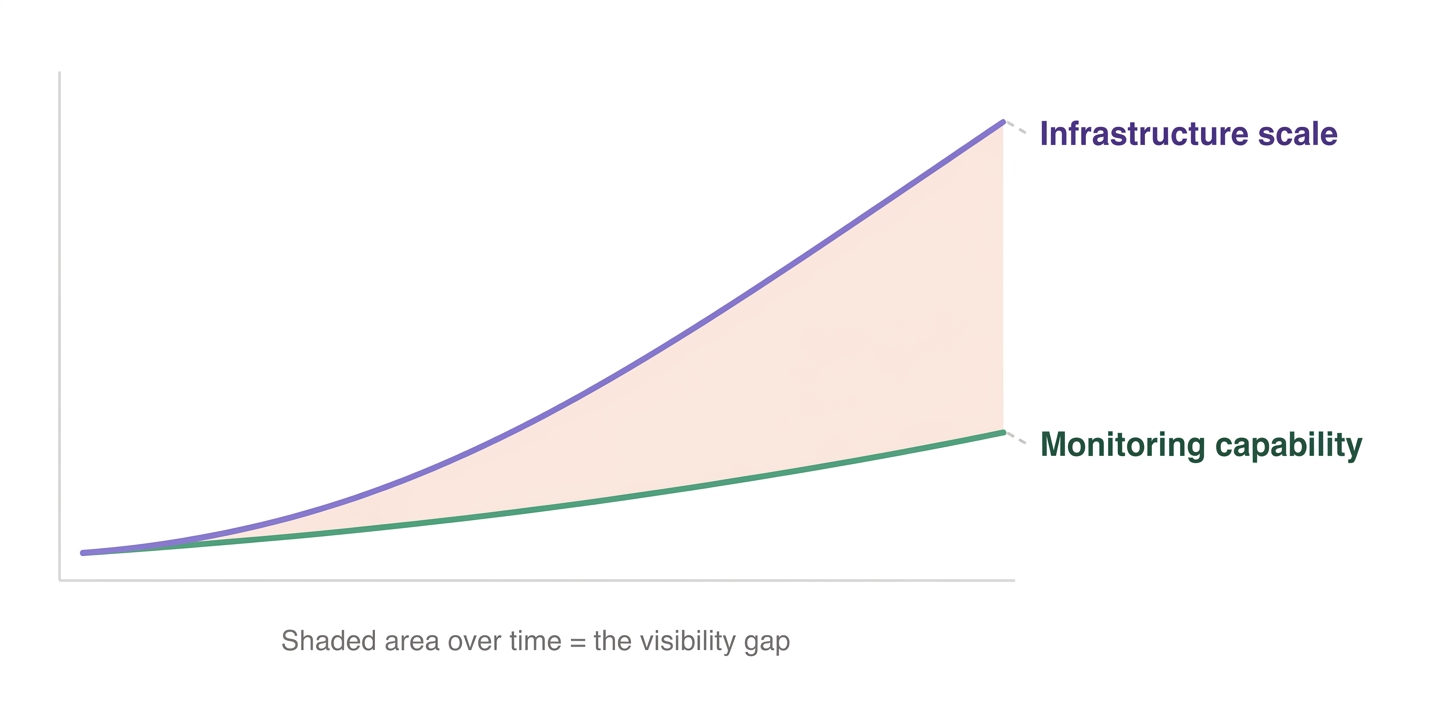
The bottom line: Infrastructure is scaling exponentially, but monitoring architectures built for yesterday’s environments are becoming tomorrow’s operational risk.
The New Playbook: Engineering Observability for Modern Storage Networks
1. The Concurrency Architect: Replace Sequential Discovery With Parallel Intelligence
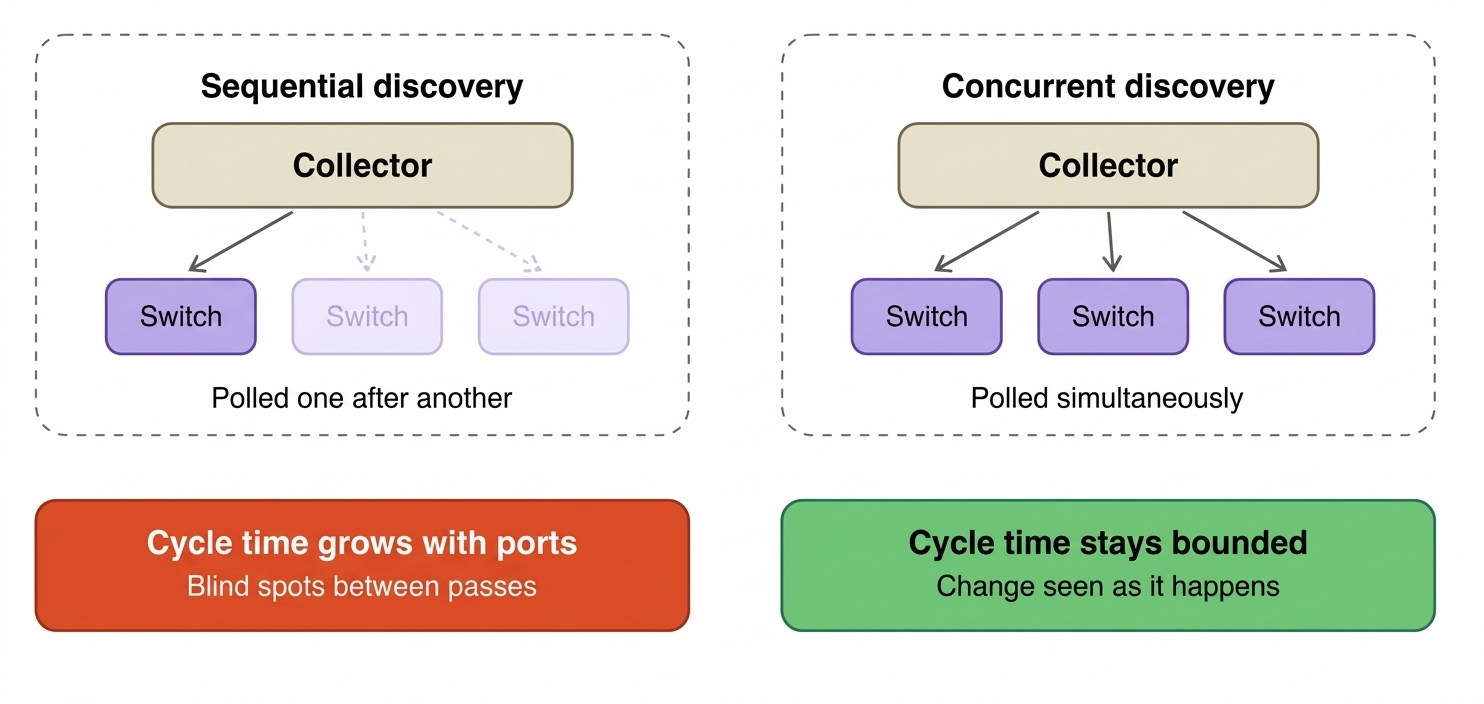
Traditional discovery workflows often treat infrastructure mapping as a checklist: find one device, collect information, move to the next. That approach collapses under enterprise-scale environments.
Modern discovery requires concurrent workflows that can collect, process, and correlate information from thousands of network elements simultaneously. The engineering challenge is not simply adding more processing power. It is designing systems that distribute workload efficiently while maintaining accuracy and consistency.
High-scale discovery platforms must think like distributed systems, where parallel execution, workload management, and fault tolerance determine whether visibility keeps pace with infrastructure growth.
2. The Telemetry Engineer: Turn Monitoring Into a High-Throughput Pipeline
Everyone focuses on dashboards. The harder problem is the data engine underneath.
Performance monitoring depends on collecting massive volumes of operational signals from switches, ports, flows, and connected systems. A scalable architecture requires efficient ingestion, buffering, processing, and storage pipelines that can handle continuous data streams without creating bottlenecks.
The strongest monitoring platforms are not built around periodic snapshots. They are built around real-time intelligence pipelines capable of transforming raw telemetry into actionable operational signals.
3. The Fabric Historian: Understand Networks as Living Systems
Storage fabrics are not static diagrams. They are constantly changing ecosystems.
A switch added today changes capacity planning tomorrow. A routing adjustment can affect performance weeks later. A failed component can expose hidden dependencies that were invisible during normal operations.
Effective monitoring requires historical context. Engineers need systems that understand how environments evolve, not just systems that report current conditions. This shift transforms monitoring from a reactive troubleshooting tool into a predictive operational capability.
4. The Performance Engineer: Optimise the Engine Before Expanding the Hardware
A common misconception is that scale problems are solved by adding infrastructure. Often, the deeper issue is inefficient software design.
Performance improvements frequently come from better concurrency models, optimised memory usage, efficient data processing, and careful analysis of application behaviour under load. Profiling and tuning distributed systems can extend platform capacity without increasing operational complexity.
The best scalability improvements are architectural, not incremental.
5. The Compliance Translator: Convert Technical Visibility Into Business Assurance
Regulated industries do not only need operational awareness. They need evidence.
A storage monitoring platform becomes strategically valuable when it can demonstrate that infrastructure controls are functioning consistently. Discovery accuracy, monitoring completeness, access governance, and historical records all contribute to audit confidence.
The future of infrastructure management is where engineering capability and compliance responsibility meet.
Case Studies in the Wild: How Scale Changes Infrastructure Thinking
A large virtualization platform vendor: Infrastructure visibility became a platform challenge. As virtualized environments expanded across enterprise data centres, operational teams faced increasing complexity across compute, storage, and networking layers. The crucial lesson is that visibility must expand alongside infrastructure abstraction. Monitoring cannot remain limited to individual components when applications depend on interconnected systems.
A global technology infrastructure provider: Distributed systems required distributed thinking. Organisations operating some of the world’s largest digital platforms learned that reliability depends on designing systems for scale, failure recovery, and continuous operation from the beginning. The crucial lesson is that monitoring cannot be added after growth happens. It must be embedded into the architecture.
A major digital services company: Observability became an engineering discipline. Companies managing large-scale customer-facing platforms moved beyond traditional alerts and dashboards by building practices around understanding complex distributed environments. The crucial lesson is that modern reliability depends on collecting, analysing, and acting on signals before users experience disruption.
The Action Plan: Building Storage Visibility That Scales
Days 0–15: Find the Visibility Gaps
Map current discovery cycles, monitoring delays, and blind spots. Identify where sequential processes prevent teams from seeing infrastructure changes quickly enough.
Measure the time between an infrastructure event and operational awareness. That gap defines the real engineering problem.
Days 16–45: Build Concurrent Foundations
Redesign discovery workflows around parallel processing. Modernise telemetry pipelines to support higher throughput and establish performance benchmarks that reflect future growth.
Prioritise architecture changes over short-term patches.
Days 46–90: Prove and Scale
Validate improvements across production-scale environments. Establish operational metrics for discovery completeness, monitoring latency, and incident response.
Create governance processes that connect technical visibility with compliance requirements.
The Inevitable Future: Infrastructure Intelligence Becomes a Core Capability
The growth of storage fabrics is not slowing down. Data-intensive applications, cloud connectivity, and digital operations will continue pushing enterprise infrastructure beyond previous limits.
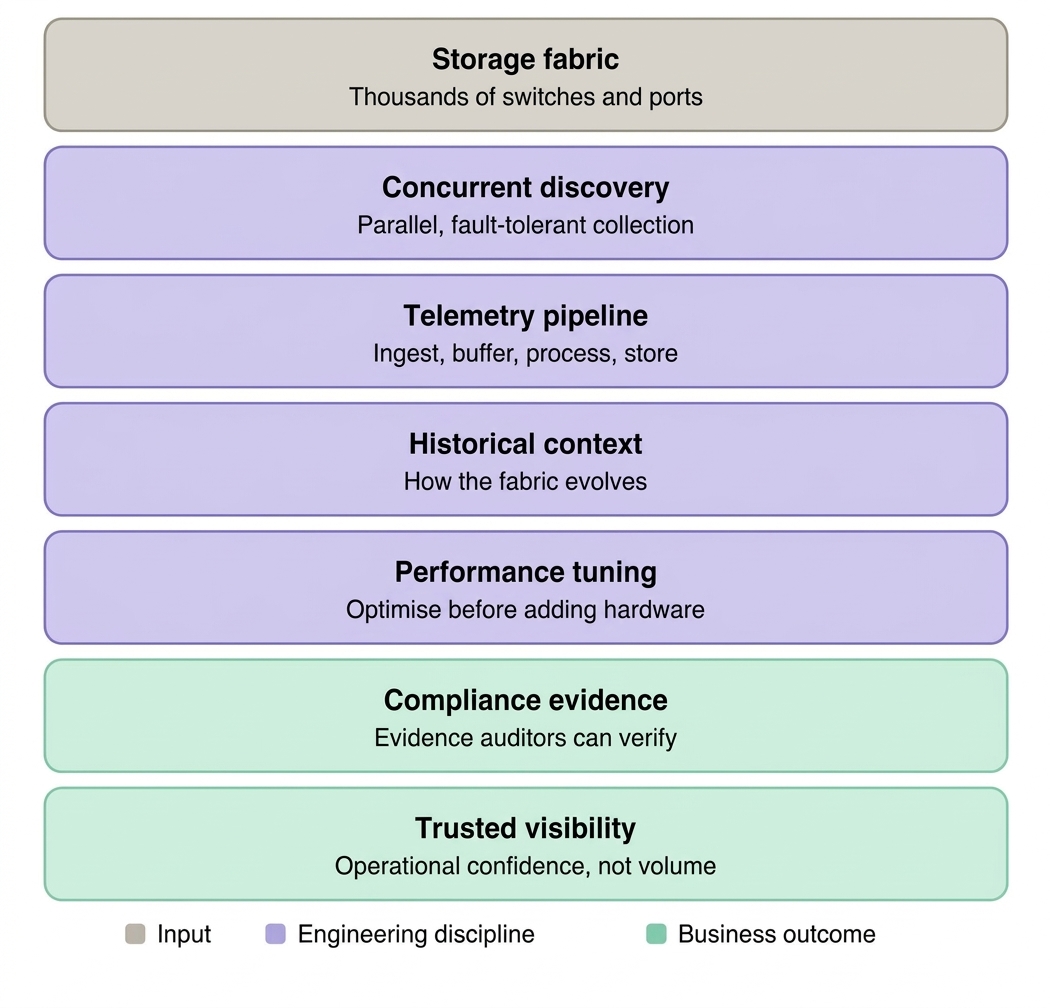
The next generation of monitoring systems will not succeed because they collect more information. They will succeed because they transform information into operational confidence.
The future belongs to organisations that treat observability as core infrastructure, not an afterthought. The most valuable currency in modern infrastructure is not data volume; it is trusted visibility.